What Is a Baby Bunny Called What Is a Male Deer Called
| Rabbit Temporal range: Tardily Eocene–Holocene, | |
|---|---|
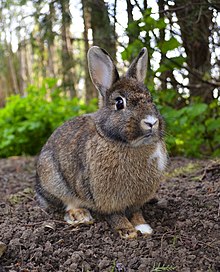 | |
| European rabbit (Oryctolagus cuniculus) | |
| Scientific classification | |
| Kingdom: | Animalia |
| Phylum: | Chordata |
| Class: | Mammalia |
| Order: | Lagomorpha |
| Family: |
|
| Genera | |
| |
Rabbits, too known equally bunnies or bunny rabbits, are pocket-sized mammals in the family Leporidae (which also contains the hares) of the lodge Lagomorpha (which also contains the pikas). Oryctolagus cuniculus includes the European rabbit species and its descendants, the world'south 305 breeds[i] of domestic rabbit. Sylvilagus includes 13 wild rabbit species, among them the seven types of cottontail. The European rabbit, which has been introduced on every continent except Antarctica, is familiar throughout the globe as a wild casualty animal and every bit a domesticated form of livestock and pet. With its widespread outcome on ecologies and cultures, the rabbit is, in many areas of the world, a office of daily life—equally food, wearable, a companion, and a source of creative inspiration.
Although once considered rodents, lagomorphs like rabbits take been discovered to have diverged separately and earlier than their rodent cousins and have a number of traits rodents lack, like two extra incisors.
Terminology and etymology
Male rabbits are called bucks; females are chosen does. An older term for an adult rabbit used until the 18th century is coney (derived ultimately from the Latin cuniculus ), while rabbit one time referred only to the young animals.[2] Another term for a young rabbit is bunny, though this term is often applied informally (especially by children) to rabbits generally, especially domestic ones. More recently, the term kit or kitten has been used to refer to a immature rabbit.
A group of rabbits is known as a colony or nest (or, occasionally, a warren, though this more than normally refers to where the rabbits live).[3] A group of baby rabbits produced from a single mating is referred to every bit a litter [4] and a group of domestic rabbits living together is sometimes called a herd.[5]
The discussion rabbit itself derives from the Middle English language rabet , a borrowing from the Walloon robète , which was a diminutive of the French or Middle Dutch robbe .[6]
Taxonomy
Rabbits and hares were formerly classified in the order Rodentia (rodent) until 1912, when they were moved into a new order, Lagomorpha (which also includes pikas). Beneath are some of the genera and species of the rabbit.
-

Brachylagus idahoensis
Pygmy rabbit
-

Nesolagus netscheri
Sumatran Striped Rabbit
(Model)
-
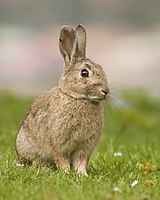
Oryctolagus cuniculus
European rabbit
(Feral Tasmanian specimen)
-

Pentalagus furnessi
Amami rabbit
(Taxidermy specimen)
-

Romerolagus diazi
Volcano rabbit
(Taxidermy specimen)
-

Sylvilagus aquaticus
Swamp rabbit
(Juvenile)
-

Sylvilagus audubonii
Desert cottontail
-
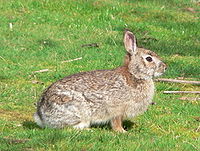
Sylvilagus bachmani
Brush rabbit
-

Sylvilagus brasiliensis
Tapeti
(Taxidermy specimen)
-

Sylvilagus palustris hefneri
Lower Keys marsh rabbit
- Club Lagomorpha
- Family unit Leporidae (in part)
- Genus Brachylagus
- Pygmy rabbit, Brachylagus idahoensis
- Genus Bunolagus
- Bushman rabbit, Bunolagus monticularis
- Genus Lepus [a]
- Genus Nesolagus
- Sumatran striped rabbit, Nesolagus netscheri
- Annamite striped rabbit, Nesolagus timminsi
- Genus Oryctolagus
- European rabbit, Oryctolagus cuniculus
- Genus Pentalagus
- Amami rabbit/Ryūkyū rabbit, Pentalagus furnessi
- Genus Poelagus
- Fundamental African Rabbit, Poelagus marjorita
- Genus Romerolagus
- Volcano rabbit, Romerolagus diazi
- Genus Sylvilagus
- Swamp rabbit, Sylvilagus aquaticus
- Desert cottontail, Sylvilagus audubonii
- Brush rabbit, Sylvilagus bachmani
- Forest rabbit, Sylvilagus brasiliensis
- Mexican cottontail, Sylvilagus cunicularis
- Dice's cottontail, Sylvilagus dicei
- Eastern cottontail, Sylvilagus floridanus
- Tres Marias rabbit, Sylvilagus graysoni
- Omilteme cottontail, Sylvilagus insonus
- San Jose castor rabbit, Sylvilagus mansuetus
- Mountain cottontail, Sylvilagus nuttallii
- Marsh rabbit, Sylvilagus palustris
- New England cottontail, Sylvilagus transitionalis
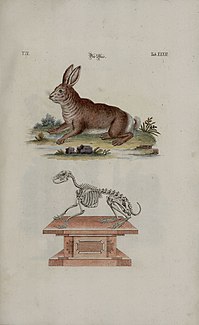
Hare
Johann Daniel Meyer (1748)
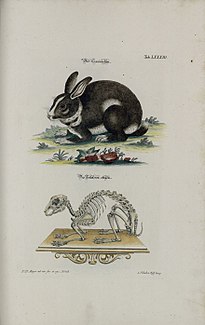
Rabbit
Johann Daniel Meyer (1748)
Differences from hares
The term "rabbit" is typically used for all Leporidae species excluding the genus Lepus. Members of that genus are instead known as hares or jackrabbits.
Lepus species are typically precocial, born relatively mature and mobile with pilus and good vision, while other rabbit species are altricial, born hairless and blind, and requiring closer intendance. Hares live a relatively solitary life in a simple nest in a higher place the ground, while most other rabbits live in social groups in burrows or warrens. Hares are generally larger than other rabbits, with ears that are more elongated, and with hind legs that are larger and longer. Descendants of the European rabbit are unremarkably bred as livestock and kept equally pets, whereas no hares accept been domesticated - the breed called the Belgian hare is a domestic rabbit which has been selectively bred to resemble a hare.
Domestication
Rabbits have long been domesticated. Beginning in the Middle Ages, the European rabbit has been widely kept as livestock, starting in ancient Rome. Selective breeding has generated a wide variety of rabbit breeds, of which many (since the early 19th century) are also kept equally pets. Some strains of rabbit have been bred specifically as research subjects.
As livestock, rabbits are bred for their meat and fur. The earliest breeds were important sources of meat, and so became larger than wild rabbits, but domestic rabbits in modern times range in size from dwarf to giant. Rabbit fur, prized for its softness, can be found in a wide range of coat colors and patterns, likewise as lengths. The Angora rabbit brood, for example, was developed for its long, silky fur, which is often hand-spun into yarn. Other domestic rabbit breeds accept been adult primarily for the commercial fur trade, including the Rex, which has a short plush coat.
Biology
Evolution

Development of the rabbit centre
(wax models)
Because the rabbit'south epiglottis is engaged over the soft palate except when swallowing, the rabbit is an obligate nasal sabbatical. Rabbits have two sets of incisor teeth, ane behind the other. This way they can be distinguished from rodents, with which they are ofttimes confused.[7] Carl Linnaeus originally grouped rabbits and rodents under the class Glires; later, they were separated equally the scientific consensus is that many of their similarities were a effect of convergent evolution. However, contempo Deoxyribonucleic acid analysis and the discovery of a mutual antecedent has supported the view that they do share a common lineage, and thus rabbits and rodents are now ofttimes referred to together every bit members of the superorder Glires.[eight]
Morphology

Since speed and agility are a rabbit'southward main defenses against predators (including the swift play tricks), rabbits have large hind leg bones and well developed musculature. Though plantigrade at rest, rabbits are on their toes while running, assuming a more than digitigrade posture. Rabbits use their strong claws for digging and (along with their teeth) for defence.[nine] Each front pes has four toes plus a dewclaw. Each hind pes has four toes (but no dewclaw).[x]
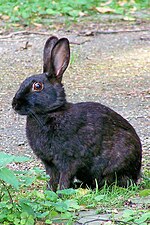
Melanistic coloring
Oryctologus cuniculusEuropean rabbit (wild)
Most wild rabbits (especially compared to hares) have relatively full, egg-shaped bodies. The soft coat of the wild rabbit is agouti in coloration (or, rarely, melanistic), which aids in camouflage. The tail of the rabbit (with the exception of the cottontail species) is nighttime on meridian and white below. Cottontails have white on the height of their tails.[11]
As a result of the position of the optics in its skull, the rabbit has a field of vision that encompasses nearly 360 degrees, with merely a small-scale bullheaded spot at the bridge of the nose.[12]
Hind limb elements

This prototype comes from a specimen in the Pacific Lutheran University natural history drove. Information technology displays all of the skeletal articulations of rabbit'southward hind limbs.
The beefcake of rabbits' hind limbs are structurally similar to that of other land mammals and contribute to their specialized class of locomotion. The bones of the hind limbs consist of long bones (the femur, tibia, fibula, and phalanges) too every bit short bones (the tarsals). These bones are created through endochondral ossification during development. Like most land mammals, the circular head of the femur articulates with the acetabulum of the ox coxae. The femur articulates with the tibia, but not the fibula, which is fused to the tibia. The tibia and fibula articulate with the tarsals of the foot, commonly called the foot. The hind limbs of the rabbit are longer than the front limbs. This allows them to produce their hopping grade of locomotion. Longer hind limbs are more than capable of producing faster speeds. Hares, which have longer legs than cottontail rabbits, are able to move considerably faster.[13] Rabbits stay just on their toes when moving; this is chosen Digitigrade locomotion. The hind feet take four long toes that allow for this and are webbed to forestall them from spreading when hopping.[14] Rabbits do not have manus pads on their feet like most other animals that utilize digitigrade locomotion. Instead, they accept coarse compressed hair that offers protection.[15]
Musculature

The rabbits hind limb (lateral view) includes muscles involved in the quadriceps and hamstrings.
Rabbits have muscled hind legs that allow for maximum strength, maneuverability, and acceleration that is divided into three main parts; pes, thigh, and leg. The hind limbs of a rabbit are an exaggerated feature. They are much longer than the forelimbs, providing more strength. Rabbits run on their toes to proceeds the optimal stride during locomotion. The force put out by the hind limbs is contributed to both the structural anatomy of the fusion tibia and fibula, and muscular features.[16] Bone germination and removal, from a cellular standpoint, is directly correlated to hind limb muscles. Activeness pressure level from muscles creates forcefulness that is then distributed through the skeletal structures. Rabbits that generate less force, putting less stress on basic are more decumbent to osteoporosis due to bone rarefaction.[17] In rabbits, the more fibers in a muscle, the more resistant to fatigue. For example, hares have a greater resistance to fatigue than cottontails. The muscles of rabbit's hind limbs can be classified into four main categories: hamstrings, quadriceps, dorsiflexors, or plantar flexors. The quadriceps muscles are in charge of force production when jumping. Complementing these muscles are the hamstrings, which aid in brusk bursts of action. These muscles play off of one another in the aforementioned way as the plantar flexors and dorsiflexors, contributing to the generation and actions associated with strength.[18]
Ears

A Holland Lop resting with one ear up and 1 ear down. Some rabbits can adjust their ears to hear afar sounds.
Within the order lagomorphs, the ears are utilized to detect and avoid predators. In the family unit Leporidae, the ears are typically longer than they are wide. For example, in blackness tailed jack rabbits, their long ears embrace a greater surface area relative to their torso size that permit them to detect predators from far away. Assorted to cotton tailed rabbits, their ears are smaller and shorter, requiring predators to be closer to detect them before they tin can abscond. Development has favored rabbits having shorter ears so the larger surface expanse does not crusade them to lose heat in more temperate regions. The opposite tin can exist seen in rabbits that live in hotter climates, mainly because they possess longer ears that have a larger surface surface area that help with dispersion of heat as well as the theory that sound does not travel well in more arid air, opposed to cooler air. Therefore, longer ears are meant to help the organism in detecting predators sooner rather than later in warmer temperatures.[19] [ page needed ] The rabbit is characterized by its shorter ears while hares are characterized by their longer ears.[twenty] [ page needed ] Rabbits' ears are an of import structure to assist thermoregulation and find predators due to how the outer, centre, and inner ear muscles coordinate with one another. The ear muscles likewise assistance in maintaining residuum and movement when fleeing predators.[21]
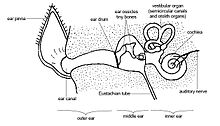
Outer ear
The auricle, as well known as the pinna, is a rabbit's outer ear.[22] The rabbit'due south pinnae represent a fair part of the body surface surface area. Information technology is theorized that the ears aid in dispersion of heat at temperatures to a higher place 30 °C with rabbits in warmer climates having longer pinnae due to this. Another theory is that the ears function as shock absorbers that could aid and stabilize rabbit's vision when fleeing predators, just this has typically only been seen in hares.[23] [ page needed ] The balance of the outer ear has bent canals that lead to the eardrum or tympanic membrane.[24]
Eye ear
The middle ear is filled with 3 bones chosen ossicles and is separated past the outer eardrum in the back of the rabbit's skull. The iii ossicles are called hammer, anvil, and stirrup and deed to subtract sound before it hits the inner ear. In general, the ossicles deed as a bulwark to the inner ear for sound energy.[24]
Inner ear
Inner ear fluid called endolymph receives the sound free energy. After receiving the energy, later within the inner ear at that place are two parts: the cochlea that utilizes sound waves from the ossicles and the vestibular apparatus that manages the rabbit's position in regards to movement. Within the cochlea at that place is a basilar membrane that contains sensory hair structures utilized to send nervus signals to the brain so it can recognize different sound frequencies. Within the vestibular apparatus the rabbit possesses three semicircular canals to help notice athwart motion.[24]
Thermoregulation
Thermoregulation is the process that an organism utilizes to maintain an optimal body temperature independent of external conditions.[25] This process is carried out by the pinnae, which takes up about of the rabbit's body surface and comprise a vascular network and arteriovenous shunts.[26] In a rabbit, the optimal body temperature is around 38.five–forty℃.[27] If their body temperature exceeds or does not meet this optimal temperature, the rabbit must render to homeostasis. Homeostasis of torso temperature is maintained by the employ of their large, highly vascularized ears that are able to change the corporeality of blood flow that passes through the ears.
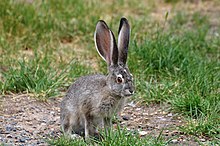
Rabbits utilize their large vascularized ears, which assist in thermoregulation, to keep their body temperature at an optimal level.
Constriction and dilation of blood vessels in the ears are used to control the core trunk temperature of a rabbit. If the cadre temperature exceeds its optimal temperature greatly, blood flow is constricted to limit the corporeality of blood going through the vessels. With this constriction, at that place is just a express corporeality of blood that is passing through the ears where ambience heat would be able to oestrus the blood that is flowing through the ears and therefore, increasing the body temperature. Constriction is also used when the ambient temperature is much lower than that of the rabbit's core body temperature. When the ears are constricted information technology again limits blood flow through the ears to conserve the optimal body temperature of the rabbit. If the ambient temperature is either fifteen degrees above or below the optimal body temperature, the claret vessels will dilate. With the claret vessels being enlarged, the claret is able to pass through the large surface expanse, causing it to either heat or cool downwardly.
During hot summers, the rabbit has the capability to stretch its pinnae, which allows for greater surface area and increase heat dissipation. In common cold winters, the rabbit does the reverse and folds its ears in order to decrease its surface area to the ambient air, which would decrease their body temperature.
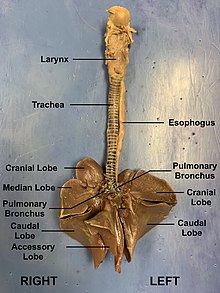
Ventral view of dissected rabbit lungs with key structures labeled.
The jackrabbit has the largest ears within the Oryctolagus cuniculus grouping. Their ears contribute to 17% of their total body area. Their large pinna were evolved to maintain homeostasis while in the extreme temperatures of the desert.
Respiratory organization
The rabbit's nasal cavity lies dorsal to the oral fissure, and the two compartments are separated by the difficult and soft palate.[28] The nasal cavity itself is separated into a left and right side by a cartilage bulwark, and information technology is covered in fine hairs that trap grit before it can enter the respiratory tract.[28] [29] [ folio needed ] Every bit the rabbit breathes, air flows in through the nostrils forth the alar folds. From in that location, the air moves into the nasal cavity, also known as the nasopharynx, down through the trachea, through the larynx, and into the lungs.[29] [ page needed ] [30] The larynx functions as the rabbit's vox box, which enables it to produce a wide variety of sounds.[29] [ page needed ] The trachea is a long tube embedded with cartilaginous rings that foreclose the tube from collapsing as air moves in and out of the lungs. The trachea so splits into a left and right bronchus, which come across the lungs at a structure called the hilum. From there, the bronchi separate into progressively more narrow and numerous branches. The bronchi branch into bronchioles, into respiratory bronchioles, and ultimately terminate at the alveolar ducts. The branching that is typically constitute in rabbit lungs is a clear instance of monopodial branching, in which smaller branches divide out laterally from a larger central co-operative.[31]
The structure of the rabbit's nasal and oral cavities, necessitates breathing through the nose. This is due to the fact that the epiglottis is stock-still to the backmost portion of the soft palate.[30] Within the oral cavity, a layer of tissue sits over the opening of the glottis, which blocks airflow from the oral cavity to the trachea.[28] The epiglottis functions to prevent the rabbit from aspirating on its food. Further, the presence of a soft and hard palate allow the rabbit to breathe through its nose while it feeds.[29] [ folio needed ]

Monopodial branching as seen in dissected rabbit lungs.
Rabbits lungs are divided into four lobes: the cranial, middle, caudal, and accessory lobes. The right lung is made up of all four lobes, while the left lung but has two: the cranial and caudal lobes.[31] In club to provide infinite for the heart, the left cranial lobe of the lungs is significantly smaller than that of the right.[28] The diaphragm is a muscular structure that lies caudal to the lungs and contracts to facilitate respiration.[28] [thirty]
Digestion
Rabbits are herbivores that feed by grazing on grass and other leafy plants. In consequence, their nutrition contains large amounts of cellulose, which is hard to digest. Rabbits solve this trouble via a course of hindgut fermentation. They pass two distinct types of feces: hard droppings and soft black mucilaginous pellets, the latter of which are known as caecotrophs or "night droppings" [32] and are immediately eaten (a behaviour known as coprophagy). Rabbits reingest their own droppings (rather than chewing the cud every bit exercise cows and numerous other herbivores) to assimilate their food further and extract sufficient nutrients.[33]
Rabbits graze heavily and rapidly for roughly the commencement one-half-hour of a grazing period (normally in the late afternoon), followed by about half an hour of more selective feeding.[ citation needed ] In this time, the rabbit will besides excrete many hard fecal pellets, being waste matter pellets that will not be reingested.[ commendation needed ] If the environment is relatively non-threatening, the rabbit will remain outdoors for many hours, grazing at intervals.[ commendation needed ] While out of the burrow, the rabbit will occasionally reingest its soft, partially digested pellets; this is rarely observed, since the pellets are reingested as they are produced.[ citation needed ]
Video of a wild European rabbit with ears twitching and a jump
Hard pellets are made up of hay-like fragments of establish cuticle and stalk, being the terminal waste product afterwards redigestion of soft pellets. These are only released outside the couch and are not reingested. Soft pellets are usually produced several hours after grazing, afterwards the hard pellets accept all been excreted.[ commendation needed ] They are made up of micro-organisms and undigested plant cell walls.[ commendation needed ]
Rabbits are hindgut digesters. This means that almost of their digestion takes place in their large intestine and cecum. In rabbits, the cecum is about 10 times bigger than the stomach and it forth with the large intestine makes up roughly 40% of the rabbit'due south digestive tract.[34] The unique musculature of the cecum allows the abdominal tract of the rabbit to split fibrous fabric from more digestible material; the gristly material is passed equally feces, while the more nutritious material is encased in a mucous lining equally a cecotrope. Cecotropes, sometimes called "nighttime feces", are loftier in minerals, vitamins and proteins that are necessary to the rabbit's health. Rabbits eat these to meet their nutritional requirements; the mucous coating allows the nutrients to pass through the acidic stomach for digestion in the intestines. This process allows rabbits to extract the necessary nutrients from their nutrient.[35]
The chewed establish material collects in the large cecum, a secondary chamber between the large and small intestine containing large quantities of symbiotic bacteria that aid with the digestion of cellulose and too produce sure B vitamins. The pellets are most 56% bacteria by dry out weight, largely bookkeeping for the pellets existence 24.4% protein on average. The soft feces grade hither and contain upwardly to v times the vitamins of hard feces. Later existence excreted, they are eaten whole by the rabbit and redigested in a special role of the stomach. The pellets remain intact for upwardly to six hours in the stomach; the leaner within continue to digest the establish carbohydrates. This double-digestion procedure enables rabbits to use nutrients that they may have missed during the kickoff passage through the gut, every bit well as the nutrients formed by the microbial activity and thus ensures that maximum nutrition is derived from the food they swallow.[11] This procedure serves the aforementioned purpose in the rabbit every bit rumination does in cattle and sheep.[36]

Dissected prototype of the male person rabbit reproductive organisation with key structures labeled.
Because rabbits cannot vomit,[37] if buildup occurs within the intestines (due often to a diet with insufficient fibre),[38] abdominal blockage can occur.[39]
Reproduction
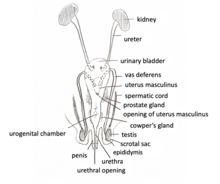
Diagram of the male rabbit reproductive system with main components labeled.
The adult male person reproductive arrangement forms the same as most mammals with the seminiferous tubular compartment containing the Sertoli cells and an adluminal compartment that contains the Leydig cells.[forty] The Leydig cells produce testosterone, which maintains libido[forty] and creates secondary sexual practice characteristics such as the genital tubercle and penis. The Sertoli cells triggers the production of Anti-Müllerian duct hormone, which absorbs the Müllerian duct. In an adult male rabbit, the sheath of the penis is cylinder-like and tin can exist extruded as early as 2 months of historic period.[41] The scrotal sacs lay lateral to the penis and contain epididymal fatty pads which protect the testes. Betwixt 10 and 14 weeks, the testes descend and are able to retract into the pelvic cavity in club to thermoregulate.[41] Furthermore, the secondary sex characteristics, such as the testes, are circuitous and secrete many compounds. These compounds includes fructose, citric acid, minerals, and a uniquely loftier amount of catalase.[xl]

Diagram of the female rabbit reproductive arrangement with primary components labeled.
The woman reproductive tract is bipartite, which prevents an embryo from translocating between uteri.[42] The two uterine horns communicate to two cervixes and forms one vaginal canal. Along with being bipartite, the female person rabbit does not go through an estrus cycle, which causes mating induced ovulation.[41]
The average female person rabbit becomes sexually mature at 3 to 8 months of age and can excogitate at any time of the year for the duration of her life. All the same, egg and sperm production can begin to pass up later iii years.[40] During mating, the male person rabbit will mount the female person rabbit from behind and insert his penis into the female and make rapid pelvic hip thrusts. The encounter lasts only twenty–40 seconds and after, the male person volition throw himself backwards off the female.[43]
The rabbit gestation catamenia is brusque and ranges from 28 to 36 days with an average period of 31 days. A longer gestation period volition generally yield a smaller litter while shorter gestation periods volition give birth to a larger litter. The size of a single litter tin can range from four to 12 kits allowing a female to deliver up to threescore new kits a year. Subsequently birth, the female tin can become pregnant again as early as the next twenty-four hour period.[41]
The mortality rates of embryos are high in rabbits and can exist due to infection, trauma, poor nutrition and environmental stress so a high fertility charge per unit is necessary to counter this.[41]
Sleep
Rabbits may appear to be crepuscular, only their natural inclination is toward nocturnal activeness.[44] In 2011, the boilerplate slumber time of a rabbit in captivity was calculated at eight.4 hours per day.[45] As with other prey animals, rabbits often sleep with their eyes open, and then that sudden movements will awaken the rabbit to respond to potential danger.[46]
Diseases
In improver to being at adventure of affliction from common pathogens such every bit Bordetella bronchiseptica and Escherichia coli, rabbits can contract the virulent, species-specific viruses RHD ("rabbit hemorrhagic disease", a form of calicivirus)[47] or myxomatosis. Among the parasites that infect rabbits are tapeworms (such as Taenia serialis), external parasites (including fleas and mites), coccidia species, and Toxoplasma gondii.[48] [49] Domesticated rabbits with a nutrition lacking in high fiber sources, such as hay and grass, are susceptible to potentially lethal gastrointestinal stasis.[50] Rabbits and hares are virtually never institute to exist infected with rabies and have non been known to transmit rabies to humans.[51]
Encephalitozoon cuniculi, an obligate intracellular parasite is too capable of infecting many mammals including rabbits.
Environmental

Rabbit kits one hour after birth
Rabbits are casualty animals and are therefore constantly aware of their surroundings. For example, in Mediterranean Europe, rabbits are the chief casualty of red foxes, badgers, and Iberian lynxes.[52] If confronted by a potential threat, a rabbit may freeze and observe so warn others in the warren with powerful thumps on the ground. Rabbits have a remarkably wide field of vision, and a good deal of it is devoted to overhead scanning.[53] They survive predation past burrowing, hopping away in a zig-zag motion, and, if captured, delivering powerful kicks with their hind legs. Their stiff teeth allow them to eat and to bite in guild to escape a struggle.[54] The longest-lived rabbit on record, a domesticated European rabbit living in Tasmania, died at historic period 18.[55] The lifespan of wild rabbits is much shorter; the average longevity of an eastern cottontail, for instance, is less than one year.[56]
Habitat and range
Rabbit habitats include meadows, woods, forests, grasslands, deserts and wetlands.[57] Rabbits live in groups, and the best known species, the European rabbit, lives in burrows, or rabbit holes. A group of burrows is chosen a warren.[57]
More than half the earth'southward rabbit population resides in North America.[57] They are also native to southwestern Europe, Southeast Asia, Sumatra, some islands of Japan, and in parts of Africa and South America. They are not naturally found in most of Eurasia, where a number of species of hares are present. Rabbits first entered S America relatively recently, as role of the Great American Interchange. Much of the continent has only one species of rabbit, the tapeti, while nearly of South America'due south southern cone is without rabbits.
The European rabbit has been introduced to many places around the earth.[xi]
Rabbits accept been launched into space orbit.[58]
Environmental problems
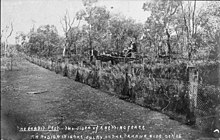
Impact of rabbit-proof fence, Cobar, New South Wales, 1905
Rabbits accept been a source of ecology problems when introduced into the wild by humans. As a result of their appetites, and the charge per unit at which they breed, feral rabbit depredation tin be problematic for agriculture. Gassing (fumigation of warrens),[59] barriers (fences), shooting, snaring, and ferreting accept been used to control rabbit populations, only the most effective measures are diseases such every bit myxomatosis (myxo or mixi, colloquially) and calicivirus. In Europe, where rabbits are farmed on a large scale, they are protected against myxomatosis and calicivirus with a genetically modified virus. The virus was developed in Spain, and is beneficial to rabbit farmers. If it were to make its way into wild populations in areas such every bit Australia, information technology could create a population nail, as those diseases are the most serious threats to rabbit survival. Rabbits in Australia and New Zealand are considered to be such a pest that land owners are legally obliged to control them.[threescore] [61]
Equally food and clothing

Saint Jerome in the Desert
[Note rabbit beingness chased by a domesticated hound]
Taddeo Crivelli (Italian, died well-nigh 1479)

Rabbit being prepared in the kitchen
Simulation of daily life, mid-15th century
Hospices de Beaune, France
In some areas, wild rabbits and hares are hunted for their meat, a lean source of loftier quality protein.[62] In the wild, such hunting is accomplished with the aid of trained falcons, ferrets, or dogs, besides as with snares or other traps, and rifles. A caught rabbit may be dispatched with a sharp blow to the dorsum of its head, a practice from which the term rabbit punch is derived.
Wild leporids contain a modest portion of global rabbit-meat consumption. Domesticated descendants of the European rabbit (Oryctolagus cuniculus) that are bred and kept as livestock (a practice called cuniculture) business relationship for the estimated 200 million tons of rabbit meat produced annually.[63] Approximately 1.2 billion rabbits are slaughtered each year for meat worldwide.[64] In 1994, the countries with the highest consumption per capita of rabbit meat were Malta with 8.89 kg (19 lb ten oz), Italy with v.71 kg (12 lb nine oz), and Cyprus with 4.37 kg (9 lb 10 oz), falling to 0.03 kg (ane oz) in Nihon. The figure for the United states of america was 0.14 kg (v oz) per capita. The largest producers of rabbit meat in 1994 were People's republic of china, Russian federation, Italy, France, and Kingdom of spain.[65] Rabbit meat was once a common commodity in Sydney, Australia, but declined afterward the myxomatosis virus was intentionally introduced to control the exploding population of feral rabbits in the area.
In the United kingdom, fresh rabbit is sold in butcher shops and markets, and some supermarkets sell frozen rabbit meat. At farmers markets in that location, including the famous Civic Marketplace in London, rabbit carcasses are sometimes displayed hanging, unbutchered (in the traditional style), adjacent to braces of pheasant or other small game. Rabbit meat is a characteristic of Moroccan cuisine, where information technology is cooked in a tajine with "raisins and grilled almonds added a few minutes before serving".[66] In China, rabbit meat is specially popular in Sichuan cuisine, with its stewed rabbit, spicy diced rabbit, BBQ-style rabbit, and even spicy rabbit heads, which accept been compared to spicy duck neck.[63] Rabbit meat is comparatively unpopular elsewhere in the Asia-Pacific.
An extremely rare infection associated with rabbits-as-nutrient is tularemia (besides known as rabbit fever), which may be contracted from an infected rabbit.[67] Hunters are at higher risk for tularemia because of the potential for inhaling the leaner during the skinning process.
In add-on to their meat, rabbits are used for their wool, fur, and pelts, as well equally their nitrogen-rich manure and their high-protein milk.[68] Product industries have developed domesticated rabbit breeds (such as the well-known Angora rabbit) to efficiently fill these needs.
In art, literature, and culture
Rabbits are often used as a symbol of fertility or rebirth, and have long been associated with jump and Easter every bit the Easter Bunny. The species' office as a prey creature with few defenses evokes vulnerability and innocence, and in sociology and modern children'southward stories, rabbits ofttimes appear every bit sympathetic characters, able to connect easily with youth of all kinds (for example, the Velveteen Rabbit, or Thumper in Bambi).
With its reputation as a prolific breeder, the rabbit juxtaposes sexuality with innocence, every bit in the Playboy Bunny. The rabbit (as a swift prey animal) is also known for its speed, agility, and endurance, symbolized (for example) past the marketing icons the Energizer Bunny and the Duracell Bunny.
Folklore
The rabbit often appears in folklore as the trickster archetype, as he uses his cunning to outwit his enemies.
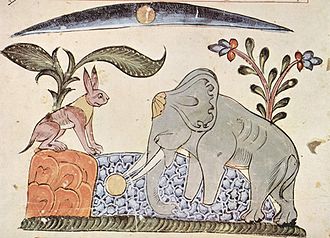
"Rabbit fools Elephant past showing the reflection of the moon".
Illustration (from 1354) of the Panchatantra

- In Aztec mythology, a pantheon of four hundred rabbit gods known as Centzon Totochtin, led past Ometochtli or Two Rabbit, represented fertility, parties, and drunkenness.
- In Fundamental Africa, the common hare (Kalulu), is "inevitably described" as a trickster figure.[69]
- In Chinese folklore, rabbits back-trail Chang'east on the Moon. In the Chinese New year, the zodiacal rabbit is one of the twelve celestial animals in the Chinese zodiac. Note that the Vietnamese zodiac includes a zodiacal cat in place of the rabbit, possibly because rabbits did non inhabit Vietnam.[ commendation needed ] The almost common explanation, nonetheless, is that the ancient Vietnamese discussion for "rabbit" (mao) sounds like the Chinese discussion for "cat" (卯, mao).[seventy]
- In Japanese tradition, rabbits live on the Moon where they brand mochi, the popular snack of mashed sticky rice. This comes from interpreting the pattern of dark patches on the moon as a rabbit standing on tiptoes on the left pounding on an usu, a Japanese mortar.
- In Jewish sociology, rabbits (shfanim שפנים) are associated with cowardice, a usage still current in gimmicky Israeli spoken Hebrew (similar to the English colloquial utilize of "chicken" to announce cowardice).
- In Korean mythology, equally in Japanese, rabbits alive on the moon making rice cakes ("Tteok" in Korean).
- In Anishinaabe traditional beliefs, held past the Ojibwe and another Native American peoples, Nanabozho, or Bully Rabbit, is an important deity related to the creation of the world.
- A Vietnamese mythological story portrays the rabbit of innocence and youthfulness. The Gods of the myth are shown to be hunting and killing rabbits to show off their power.
- Buddhism, Christianity, and Judaism have associations with an ancient circular motif called the three rabbits (or "three hares"). Its pregnant ranges from "peace and tranquility", to purity or the Holy Trinity, to Kabbalistic levels of the soul or to the Jewish diaspora. The tripartite symbol also appears in heraldry and even tattoos.
The rabbit as trickster is a office of American popular culture, as Br'er Rabbit (from African-American folktales and, later, Disney animation) and Bugs Bunny (the drawing character from Warner Bros.), for example.
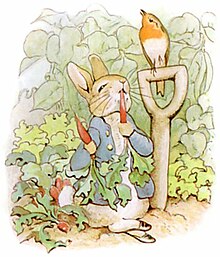
Anthropomorphized rabbits take appeared in flick and literature, in Alice's Adventures in Wonderland (the White Rabbit and the March Hare characters), in Watership Downwardly (including the film and television adaptations), in Rabbit Hill (by Robert Lawson), and in the Peter Rabbit stories (by Beatrix Potter). In the 1920s, Oswald the Lucky Rabbit, was a pop cartoon character.

WWII USAF pilot D. R. Emerson
"flys with a rabbit'south human foot talisman,
a gift from a New York girl friend"
A rabbit's human foot may be carried as an amulet, believed to bring protection and good luck. This conventionalities is establish in many parts of the world, with the earliest use being recorded in Europe c. 600 BC.[71]
On the Isle of Portland in Dorset, United kingdom, the rabbit is said to be unlucky and even speaking the creature's proper noun can cause upset amid older island residents. This is idea to appointment back to early on times in the local quarrying industry where (to save infinite) extracted stones that were not fit for auction were set aside in what became tall, unstable walls. The local rabbits' tendency to burrow in that location would weaken the walls and their collapse resulted in injuries or even expiry. Thus, invoking the name of the culprit became an unlucky act to be avoided. In the local culture to this solar day, the rabbit (when he has to be referred to) may instead be called a "long ears" or "secret mutton", so as not to risk bringing a downfall upon oneself. While it was truthful 50 years ago[ when? ] that a pub on the island could be emptied by calling out the discussion "rabbit", this has go more legend than fact in modern times.[ citation needed ]
In other parts of Britain and in North America, invoking the rabbit'due south name may instead bring expert luck. "Rabbit rabbit rabbit" is one variant of an apotropaic or talismanic superstition that involves saying or repeating the word "rabbit" (or "rabbits" or "white rabbits" or some combination thereof) out loud upon waking on the first day of each calendar month, considering doing so will ensure expert fortune for the duration of that calendar month.
The "rabbit test" is a term, first used in 1949, for the Friedman test, an early diagnostic tool for detecting a pregnancy in humans. Information technology is a common misconception (or possibly an urban legend) that the examination-rabbit would die if the adult female was meaning. This led to the phrase "the rabbit died" condign a euphemism for a positive pregnancy test.
See likewise
- Animal rails
- Cuniculture
- Dwarf rabbit
- Hare games
- Jackalope
- Listing of creature names
- List of rabbit breeds
- Lop rabbit
- Rabbits in the arts
- Rabbit show jumping
References
Notes
- ^ This genus is considered a hare, non a rabbit
Citations
- ^ "Data export". DAD-IS (Domestic Brute Multifariousness Data System). FAO (Nutrient and Agronomics Organisation of the Un). 21 November 2017. Retrieved 30 March 2018.
- ^ "coney". Online Etymology Dictionary . Retrieved 2 March 2018.
- ^ "The Collective Substantive Page". Archived from the original on 1 February 2008. Retrieved xxx January 2008.
- ^ McClure, DVM PhD DACLAM, Diane (2018). "Breeding and Reproduction of Rabbits". Merck Veterinarian Transmission. Archived from the original on 6 January 2018. Retrieved v January 2018.
- ^ "Common Questions: What Do You Phone call a Grouping of...?". archived re-create of Brute Congregations, or What Do You Call a Group of.....?. U.Southward. Geological Survey Northern Prairie Wildlife Research Eye. Archived from the original on 20 March 2015. Retrieved 26 February 2018.
- ^ "rabbit". Online Etymology Dictionary . Retrieved 15 July 2021.
- ^ Brown, Louise (2001). How to Care for Your Rabbit. Kingdom Books. p. 6. ISBN978-1-85279-167-4.
- ^ Katherine Quesenberry & James W. Carpenter, Ferrets, Rabbits, and Rodents: Clinical Medicine and Surgery (tertiary ed. 2011).
- ^ d'Ovidio, Dario; Pierantoni, Ludovica; Noviello, Emilio; Pirrone, Federica (September 2016). "Sex activity differences in man-directed social beliefs in pet rabbits". Journal of Veterinary Beliefs. xv: 37–42. doi:10.1016/j.jveb.2016.08.072.
- ^ van Praag, Esther (2005). "Plain-featured claws in a rabbit, after traumatic fractures" (PDF). MediRabbit.
- ^ a b c "rabbit". Encyclopædia Britannica (Standard ed.). Chicago: Encyclopædia Britannica, Inc. 2007.
- ^ "What practise Rabbits See?". Archived from the original on 23 September 2015. Retrieved 9 August 2013.
- ^ Bensley, Benjamin Arthur (1910). Applied anatomy of the rabbit. The Academy Press. p. ane.
rabbit skeletal beefcake.
- ^ "Description and Concrete Characteristics of Rabbits - All Other Pets - Merck Veterinary Transmission". Merck Veterinary Manual . Retrieved 11 May 2018.
- ^ D.A.B.V.P., Margaret A. Wissman, D.V.1000. "Rabbit Anatomy". exoticpetvet.net . Retrieved 11 May 2018.
- ^ Susan., Lumpkin (2011). Rabbits : the animal answer guide. Seidensticker, John. Baltimore: Johns Hopkins University Printing. ISBN9781421401263. OCLC 794700391.
- ^ Geiser, Max; Trueta, Joseph (May 1958). "Musculus activeness, bone rarefaction and bone germination". The Journal of Bone and Articulation Surgery. British Book. forty-B (2): 282–311. doi:x.1302/0301-620X.40B2.282. PMID 13539115.
- ^ Lieber, Richard L.; Blevins, Field T. (January 1989). "Skeletal muscle architecture of the rabbit hindlimb: Functional implications of muscle blueprint". Periodical of Morphology. 199 (1): 93–101. doi:10.1002/jmor.1051990108. PMID 2921772. S2CID 25344889.
- ^ Hall, E. Raymond (2001). The Mammals of Northward America. The Blackburn Press. ISBN978-1930665354.
- ^ Bensley, Benjamin Arthur (1910). Applied anatomy of the rabbit. The University Printing.
- ^ Meyer, D. L. (1971). "Single Unit Responses of Rabbit Ear-Muscles to Postural and Accelerative Stimulation". Experimental Brain Research. 14 (2): 118–26. doi:10.1007/BF00234795. PMID 5016586. S2CID 6466476.
- ^ Capello, Vittorio (2006). "Lateral Ear Canal Resection and Ablation in Pet Rabbits" (PDF). The N American Veterinary Conference. 20: 1711–1713.
- ^ Vella, David (2012). Ferrets, Rabbits, and Rodents: Clinical Medicine and Surgery. Elsevier. ISBN978-one-4160-6621-7.
- ^ a b c Parsons, Paige K. (2018). "Rabbit Ears: A Structural Expect: ...injury or disease, can send your rabbit into a spin". House Rabbit Gild.
- ^ Romanovsky, A. A. (March 2014). "Skin temperature: its role in thermoregulation". Acta Physiologica. 210 (three): 498–507. doi:10.1111/apha.12231. PMC4159593. PMID 24716231.
- ^ Vella, David (2012). Ferrets, Rabbits, and Rodents: Clinical, Medicine, and Surgery. Elsevier. ISBN9781416066217. [ folio needed ]
- ^ Fayez, I; Marai, M; Alnaimy, A; Habeeb, M (1994). "Thermoregulation in rabbits". In Baselga, M; Marai, I.F.M. (eds.). Rabbit production in hot climates. Zaragoza: CIHEAM. pp. 33–41.
- ^ a b c d eastward Johnson-Delaney, Cathy A.; Orosz, Susan E. (2011). "Rabbit Respiratory Organization: Clinical Anatomy, Physiology and Disease". Veterinary Clinics of Due north America: Exotic Fauna Practice. 14 (2): 257–266. doi:10.1016/j.cvex.2011.03.002. PMID 21601814.
- ^ a b c d Smith, David G. (2019). A dissection guide & atlas to the rabbit. ISBN978-1617319372. OCLC 1084742187.
- ^ a b c Jekl, Vladimi (2012). "Arroyo to Rabbit Respiratory Affliction". WSAVA/FECAVA/BSAVA Earth Congress.
As obligate nasal breathers, rabbits with upper airway illness will endeavour to exhale through their mouths, which prevents feeding and drinking and could exist speedily fatal.
- ^ a b Autifi, Mohamed Abdul Haye; El-Banna, Ahmed Kamal; Ebaid, Ashraf El- Sayed (2015). "Morphological Written report of Rabbit Lung, Bronchial Tree, and Pulmonary Vessels Using Corrosion Cast Technique". Al-Azhar Assiut Medical Journal. 13 (3): 41–51.
- ^ "Rabbits: The Mystery of Poop". bio.miami.edu . Retrieved 3 Dec 2018.
- ^ "Information for Rabbit Owners — Oak Tree Veterinary Middle". Oaktreevet.co.uk. Archived from the original on 23 June 2012. Retrieved 30 August 2010.
- ^ "Feeding the Pet Rabbit"
- ^ Dr. Byron de la Navarre'due south "Intendance of Rabbits" Susan A. Brown, DVM'south "Overview of Common Rabbit Diseases: Diseases Related to Diet"
- ^ The Private Life of the Rabbit, R. M. Lockley, 1964. Chapter 10.
- ^ Bernard E. Rollin (13 March 1995). The Experimental Animal in Biomedical Research: Care, Husbandry, and Well-Beingness-An Overview by Species, Volume 2. CRC Press. p. 359. ISBN9780849349829.
- ^ Karr-Lilienthal, Phd (University of Nebraska - Lincoln), Lisa (4 November 2011). "The Digestive System of the Rabbit". eXtension (a Function of the Cooperative Extension Service). Archived from the original on half-dozen January 2018. Retrieved 5 January 2018.
- ^ "Living with a Firm Rabbit". Archived from the original on 21 September 2017. Retrieved 21 September 2017.
- ^ a b c d Foote, Robert H; Carney, Edward W (2000). "The rabbit as a model for reproductive and developmental toxicity studies". Reproductive Toxicology. 14 (6): 477–493. doi:ten.1016/s0890-6238(00)00101-v. ISSN 0890-6238. PMID 11099874.
- ^ a b c d e "Rabbit Reproduction Basics". LafeberVet. v May 2014. Retrieved 6 May 2019.
- ^ Weisbroth, Steven H.; Flatt, Ronald E.; Kraus, Alan L. (1974). The Biology of the Laboratory Rabbit. doi:10.1016/c2013-0-11681-nine. ISBN9780127421506.
- ^ "Understanding the Mating Process for Breeding Rabbits". florida4h.org . Retrieved 12 Apr 2019.
- ^ Jilge, B (1991). "The rabbit: a diurnal or a nocturnal animal?". Journal of Experimental Animate being Science. 34 (v–half-dozen): 170–183. PMID 1814463.
- ^ "40 Winks?" Jennifer S. Holland, National Geographic Vol. 220, No. one. July 2011.
- ^ Wright, Samantha (2011). For The Love of Parsley. A Guide To Your Rabbit's Near Common Behaviours. Lulu. pp. 35–36. ISBN978-ane-4467-9111-0.
- ^ Cooke, Brian Douglas (2014). Australia'south War Against Rabbits. CSIRO Publishing. ISBN978-0-643-09612-7. Archived from the original on 7 June 2014.
- ^ Wood, Maggie. "Parasites of Rabbits". Chicago Exotics, PC. Archived from the original on ii March 2013. Retrieved viii April 2013.
- ^ Boschert, Ken. "Internal Parasites of Rabbits". Net Vet. Archived from the original on 2 April 2013. Retrieved 8 April 2013.
- ^ Krempels, Dana. "GastroIntestinal Stasis, The Silent Killer". Department of Biology at the University of Miami. Archived from the original on 19 June 2017. Retrieved 21 September 2017.
- ^ "Rabies: Other Wild animals". Centers for Disease Control and Prevention. 15 Nov 2011. Archived from the original on 20 Dec 2010. Retrieved xx Dec 2012.
- ^ Fedriani, J. 1000.; Palomares, F.; Delibes, M. (1999). "Niche relations amidst three sympatric Mediterranean carnivores" (PDF). Oecologia. 121 (i): 138–148. Bibcode:1999Oecol.121..138F. CiteSeerX10.1.1.587.7215. doi:10.1007/s004420050915. JSTOR 4222449. PMID 28307883. S2CID 39202154. Archived (PDF) from the original on 4 March 2016.
- ^ Tynes, Valarie V. Beliefs of Exotic Pets Archived six May 2016 at the Wayback Machine. Wiley Blackwell, 2010, p. 70.
- ^ Davis, Susan E. and DeMello, Margo Stories Rabbits Tell: A Natural And Cultural History of A Misunderstood Animal Archived 6 May 2016 at the Wayback Machine. Lantern Books, 2003, p. 27.
- ^ Glenday, Craig (2013). Guinness World Records 2014. pp. 043. ISBN978-1-908843-15-ix.
- ^ Cottontail rabbit at Indiana Section of Natural Resource Archived 17 November 2016 at the Wayback Machine
- ^ a b c "Rabbit Habitats". Archived from the original on 4 August 2009. Retrieved 7 July 2009.
- ^ Beischer, DE; Fregly, AR (1962). "Animals and human in infinite. A chronology and annotated bibliography through the yr 1960". Us Naval School of Aviation Medicine. ONR TR ACR-64 (AD0272581). Archived from the original on 11 August 2015. Retrieved 14 June 2011.
- ^ Section of Primary Industries and Regional Development; Agriculture and Food Division; Pest and Disease Information Service (PaDIS). "Rabbit control: fumigation". agric.wa.gov.au. Government of Western Australia. Retrieved 25 September 2021.
- ^ "Feral animals in Australia — Invasive species". Surroundings.gov.au. 1 February 2010. Archived from the original on 21 July 2010. Retrieved 30 August 2010.
- ^ "Rabbits — The role of authorities — Te Ara Encyclopedia of New Zealand". Teara.govt.nz. 1 March 2009. Archived from the original on 12 June 2011. Retrieved 30 August 2010.
- ^ "Rabbit: From Farm to Table". Archived from the original on 5 July 2008.
- ^ a b Olivia Geng, French Rabbit Heads: The Newest Delicacy in Chinese Cuisine Archived xiv July 2017 at the Wayback Machine. The Wall Street Journal Blog, thirteen June 2014
- ^ "FAOSTAT". FAO . Retrieved 25 October 2019.
- ^ FAO - The Rabbit - Husbandry, health and production. Archived 23 Apr 2015 at the Wayback Machine
- ^ 'Traditional Moroccan Cooking, Recipes from Fez', by Madame Guinadeau. (Serif, London, 2003). ISBN 1-897959-43-v.
- ^ "Tularemia (Rabbit fever)". Health.utah.gov. sixteen June 2003. Archived from the original on 26 May 2010. Retrieved 30 August 2010.
- ^ Houdebine, Louis-Marie; Fan, Jianglin (1 June 2009). Rabbit Biotechnology: Rabbit Genomics, Transgenesis, Cloning and Models. シュプリンガー・ジャパン株式会社. pp. 68–72. ISBN978-xc-481-2226-4. Archived from the original on 26 April 2014. Retrieved 26 Feb 2018.
- ^ Brian Morris, The Power of Animals: An Ethnography, p. 177 (2000).
- ^ "Twelvemonth of the Cat OR Yr of the Rabbit?". nwasianweekly.com. 3 February 2011. Retrieved 27 February 2018.
- ^ Ellis, Bill (ane Jan 2004). Lucifer Ascending: The Occult in Sociology and Popular Culture. University Press of Kentucky. ISBN978-0813122892.
Further reading
- Windling, Terri. The Symbolism of Rabbits and Hares [usurped!]
External links
 | Wikimedia Eatables has media related to Rabbits. |
 | Wikiquote has quotations related to: Rabbit |
- American Rabbit Breeders Association organization, which promotes all phases of rabbit keeping
- House Rabbit Society an activist arrangement that promotes keeping rabbits indoors
williamsalast1947.blogspot.com
Source: https://en.wikipedia.org/wiki/Rabbit
0 Response to "What Is a Baby Bunny Called What Is a Male Deer Called"
Postar um comentário